
Special district reimbursement is often treated as an administrative task. In practice, it is a financial recovery process that affects project cash flow, compliance, and the timing of capital returned to the developer. Eligible public improvement costs do not reimburse themselves. They reimburse when the documentation supports them, when procurement met the district’s requirements, and when someone owns the process from the first invoice forward.
Here are five mistakes that cost developers time and money.
Five Special District Reimbursement Mistakes
1. Waiting too long to organize documentation
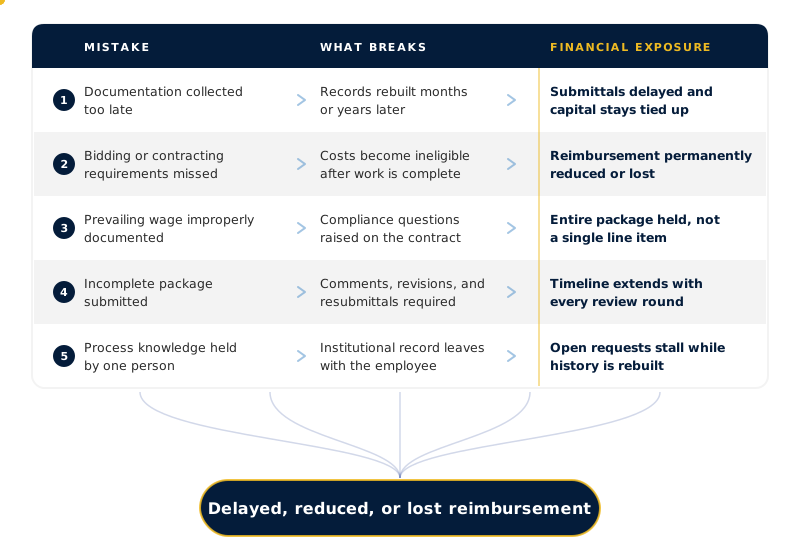
Invoices, lien releases, contracts, change orders, and proof of payment should be collected as costs are incurred, not assembled at submittal. When teams wait, they reconstruct the record months or years later, often after the project manager who authorized the work has moved on and the contractor has closed out the job.
Reconstruction delays the submittal. Every month of delay is another month of developer equity sitting in improvements the district could have already reimbursed. On a project with meaningful public improvement spend, that timing difference shows up directly in the pro forma.
2. Failing to follow bidding or contracting requirements
Most districts impose specific procurement, contracting, and approval requirements before a cost becomes reimbursable. Incorrect bidding procedures, missing contract provisions, or approvals obtained out of sequence create eligibility problems that are difficult to correct once the work is complete.
This is the most expensive category of mistake. The money is already spent, the improvement is already in the ground, and the remedy is often limited. Getting procurement right before construction costs almost nothing. Fixing it afterward may not be possible.
3. Overlooking prevailing wage requirements
Where prevailing wage applies, the contractor must pay it and document it, and the certified payroll must hold up under review. Payroll records gathered after the fact are difficult to correct, and a compliance question on one contract can hold up an entire reimbursement package rather than a single line item.
Prevailing wage requirements vary by state and by district structure. Confirm what applies to the project before the first contract is signed.
4. Submitting incomplete reimbursement packages
Missing backup triggers review comments. Review comments require a response, a revision, and a resubmittal, and each round adds time to the reimbursement timeline. A complete package moves through review. A package missing one lien release can sit behind every other submittal in the queue.
Completeness is not a matter of volume. It is a matter of the documentation hierarchy the district’s engineer expects to see, in the order they expect to see it.
5. Relying too heavily on one internal person
Reimbursement knowledge often lives with a single project manager, controller, or assistant. That person knows which costs were submitted, which were paid, what the district’s engineer asked for last time, and where the files sit.
When that person leaves, the organization loses the institutional record along with the person. Open reimbursement requests stall while someone else rebuilds the history from email and file folders. The exposure is rarely obvious until it happens.
How the LRS Reduces These Risks
The Launch Reimbursement System™ is a reimbursement management service run by Launch professionals. It is not software the client operates alone. Launch tracks district-eligible costs, organizes required documentation, identifies missing items before submittal, prepares reimbursement packages, and monitors status from the first invoice through final reimbursement.
Launch also coordinates the parties. That means working with district representatives, the jurisdiction’s engineers, contractors, and the client’s own team so that documentation keeps moving and review comments get answered by someone who has responded to that reviewer before.
Because Launch maintains the record, the process does not depend on any one employee remaining with the company. The LRS preserves the cost history, the documentation, and the submittal record at the project level, and the Launch Control Matrix™ gives management a single view of district activity, costs processed, reimbursements received, and remaining bond proceeds across projects.
Special district reimbursement is not paperwork. It is a financial recovery process, and it deserves the same discipline a developer applies to acquisition, entitlement, and construction.
Next Step
Review your reimbursement process with Launch before documentation issues delay it. Protect your reimbursable dollars with the LRS.